
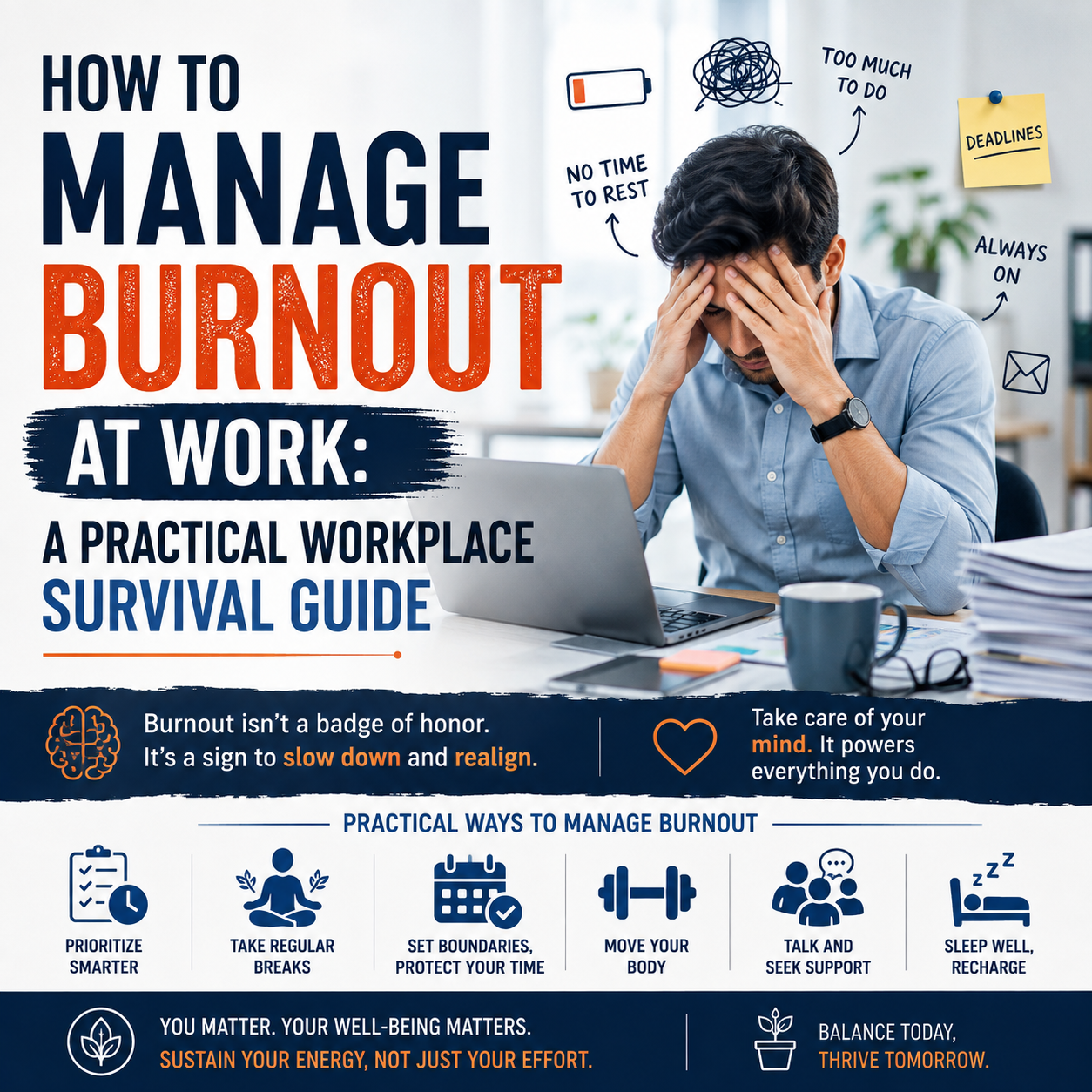
You stare at your screen at 9:15 AM on a Tuesday, completely drained before your day even starts. You have four back-to-back syncs scheduled, 32 unread Slack notifications, and a deliverables list that keeps multiplying. You aren't just tired—you are running on empty.
Understanding how to manage burnout at work has shifted from a wellness trend into an urgent professional skill. Chronic overwork silently hollows out your creativity, focus, and drive. When high performers ignore early red flags, they run headfirst into debilitating emotional exhaustion symptoms that no weekend nap can fix.
Building meaningful mental health in workplace systems requires moving past empty corporate slogans like "just take a mental health day." Whether you work in a high-pressure office or navigate remote isolation, mastering how to deal with work stress takes structural boundaries, nervous system recovery, and daily operational guardrails. Below is a deep, research-backed blueprint featuring battle-tested work life balance tips, a roadmap through the critical burnout recovery stages, and actionable systems on how to manage burnout at work without tanking your career.
What Burnout Actually Is (And What It Isn't)
Most people mistake burnout for standard exhaustion. The difference lies in its permanence. Regular tiredness goes away after two solid nights of sleep; burnout stays lodged in your nervous system.
Stress vs. Burnout Breakdown:
• Stress: Characterized by over-engagement, urgency, hyperactivity, and physical tension.
• Burnout: Characterized by disengagement, blunted emotions, chronic cynicism, and helplessness.
To stop the downward spiral, you have to catch the earliest signs of burnout before they settle into daily habits:
Cognitive Fog: Struggling to draft simple emails or prioritize tasks that used to take ten minutes.
Persistent Cynicism: Feeling resentful toward colleagues, clients, and projects you once enjoyed.
Physical Signals: Waking up unrefreshed, tension headaches, jaw clenching, and gut disturbances.
Emotional Detachment: Severe emotional exhaustion symptoms where you feel completely numb to feedback or team wins.
The shift toward flexible setups has also triggered widespread work from home burnout, where laptops turn living rooms into 24/7 cubicles. Knowing how to avoid burnout means spotting these behavioral shifts before your body forces a mandatory shutdown.
Key Pillars for Managing Work-Related Stress
1. Establish Ruthless Communication Boundaries
Most professionals burn out because they give away their focus freely. People mistake continuous responsiveness for high performance, when in reality, it just shows an absence of operational guardrails.
Strategic boundary setting at work is not about saying "no" to your boss; it is about clarifying trade-offs.
Trade-Off Framing: When handed an urgent deliverable while already at capacity, ask: "I can prioritize this report today. Should I push the client audit to Thursday, or delegate the deck review?"
Set Asynchronous Windows: Close instant messaging apps for two uninterrupted 90-minute blocks each day. Constant context-switching shreds cognitive capacity.
Hard Log-Off Protocols: Choose a fixed end time for your workday. Send your final message, close your tabs, and step away from your desk.
Setting these expectations builds realistic work-life balance in corporate environments and teaches you how to manage burnout at work systematically.
2. Run a Structured Digital Detox
If the last thing you see before sleeping is a Slack ping and the first thing you check in the morning is your work email, your brain never drops out of a threat-response state. A deliberate digital detox routine breaks this continuous feedback loop.
The 60-Minute Morning Buffer: Do not open work apps during your first hour awake. Let your dopamine baselines stabilize over breakfast, coffee, or a walk.
Device Separation: Remove work chat notifications from your personal mobile device, or set automatic Do-Not-Disturb schedules after 7:00 PM.
Screen Cut-Off: Implement an evening digital detox routine by powering down blue-light devices 60 minutes before bed to allow melatonin production to kick in.
Lowering screen-induced hyperarousal directly improves workplace anxiety management and reinforces foundational strategies on how to manage burnout at work.
3. Use Micro-Recovery and Somatic Resets
You cannot think your way out of physical exhaustion; you have to physically release stress. Integrating simple stress relief exercises for professionals keeps acute work stress from cementing into long-term fatigue.
Physiological Sighs: Take two quick inhales through your nose, followed by a long, slow exhale through your mouth. Repeating this three times rapidly drops your heart rate during stressful calls.
90-Minute Movement Resets: Sitting for eight straight hours keeps muscles contracted. Do 2 minutes of doorway chest stretches and hamstring mobility work between calls.
Sensory Grounding: Use the 5-4-3-2-1 technique (spotting 5 visible objects, 4 physical sensations, 3 sounds, 2 scents, and 1 taste) to interrupt panic spirals before difficult presentations.
Applying stress relief exercises for professionals keeps your baseline calm, restores your mental peace at work, and equips you with actionable answers for how to manage burnout at work.
4. Fix the Traps of Remote and Hybrid Setups
Remote setups eliminate commutes, but they remove the psychological buffer between work and personal life. Overcoming work from home burnout requires physical separation.
Never work from your bed or your couch. Dedicate a specific desk or corner exclusively for work. At the end of the day, shut your laptop lid, put it inside a drawer, and physically walk outside for 10 minutes to simulate an "evening commute." Applying these practical work life balance tips prevents home life from feeling like overtime, showing you how to avoid burnout over months of heavy workloads.
Navigating the Burnout Recovery Stages
True recovery takes weeks of intentional habits, not a single weekend off. Pacing yourself through the burnout recovery stages ensures you do not bounce straight back into exhaustion:
Recovery Roadmap:
1. Stabilization (Stop the Bleed) ➔ 2. Decompression (Sleep & Nutrition) ➔ 3. System Redesign (Audit Workload) ➔ 4. Reintegration (Strict Guardrails)
Stabilization: Strip non-essential tasks from your plate immediately. Delegate low-value meetings.
Decompression: Rebuild baseline sleep, hydration, and nutrition without worrying about optimization or side projects.
System Redesign: Identify the exact triggers that caused the crash—whether it was unmanaged scope creep, lack of support, or personal overcommitment.
Reintegration: Step back into full workflows using reinforced work life balance in corporate practices and refined workplace anxiety management techniques.
Moving methodically through these burnout recovery stages is the most sustainable way to protect your health, secure mental peace at work, and master how to manage burnout at work.
Transforming Team Dynamics and Support Systems
Individual coping strategies can only do so much in an unhealthy environment. Real, long-term improvement in mental health in workplace settings requires honest conversations with leadership.
Good managers care about sustainable output over short bursts of hyper-productivity. Schedule transparent check-ins with your team to discuss workload distribution. Companies that prioritize corporate stress management experience lower turnover and higher strategic output. By discussing how to deal with work stress openly, you help create a healthier culture, making how to manage burnout at work a collective standard rather than an individual burden.
Daily Burnout Prevention Checklist
Use this quick checklist to keep your routine balanced:
Applied clear work life balance tips during morning and evening routines.
Identified early signs of burnout and adjusted daily workload accordingly.
Followed a scheduled digital detox routine after logging off.
Used real-time workplace anxiety management techniques during high-pressure tasks.
Consistently executed how to manage burnout at work frameworks across your weekly workflow.
Frequently Asked Questions (FAQs)
1. What are the key differences between ordinary fatigue and genuine signs of burnout?
Fatigue resolves with a weekend of rest and sleep. The signs of burnout persist over weeks, accompanied by cynicism, brain fog, chronic dread before logging in, and emotional detachment from work.
2. How can I start boundary setting at work without looking unmotivated?
Frame your boundaries around task quality and priority. Instead of flatly declining tasks, offer alternative timelines, ask your manager to help prioritize existing deliverables, and clearly communicate your standard response hours.
3. Why is work from home burnout so common among remote teams?
Remote setups remove physical transitions between office and home. Without a physical commute or separate office, professionals often stay logged on longer, respond to late-night pings, and skip restorative breaks.
4. How much time does it take to move through all burnout recovery stages?
Mild burnout can often be managed within 2 to 4 weeks with proper rest and boundary adjustments. Severe, long-term burnout often requires 8 to 12 weeks of structured recovery, routine audits, and lifestyle changes.
5. What are the fastest stress relief exercises for professionals during tight deadlines?
Diaphragmatic breathing (such as the double-inhale physiological sigh), quick neck-and-shoulder stretches, and brief walks away from all screens can reset your nervous system in less than two minutes.
6. Why is corporate stress management vital for business retention?
Chronic stress leads to employee turnover, higher error rates, and communication friction. Proactive stress management creates sustainable performance, improves focus, and builds resilient teams.