Walking into an interview room or hopping onto an executive video panel without a clear framework for your answers is a recipe for rambling. When interviewers evaluate candidates for competitive roles, they do not just assess technical competence; they evaluate structured communication, situational composure, and problem-solving methodologies. Navigating behavioral interview questions and answers effectively separates top-tier candidates from average applicants.
Many professionals falter during interviews because they treat behavioral questions as casual storytelling opportunities rather than structured demonstrations of capability. Hiring committees use situational prompts to predict your future performance based on past actions. When asked about conflict, technical failure, or tight deadlines, providing an unstructured response dilutes your professional track record.
Mastering behavioral interview questions and answers requires a repeatable framework that delivers conciseness, measurable impact, and clarity. Whether you are a recent graduate preparing for early technical rounds or a seasoned leader navigating executive panels, this complete job interview tips guide provides the exact answers and strategies you need to succeed.
The STAR Method Framework Explained
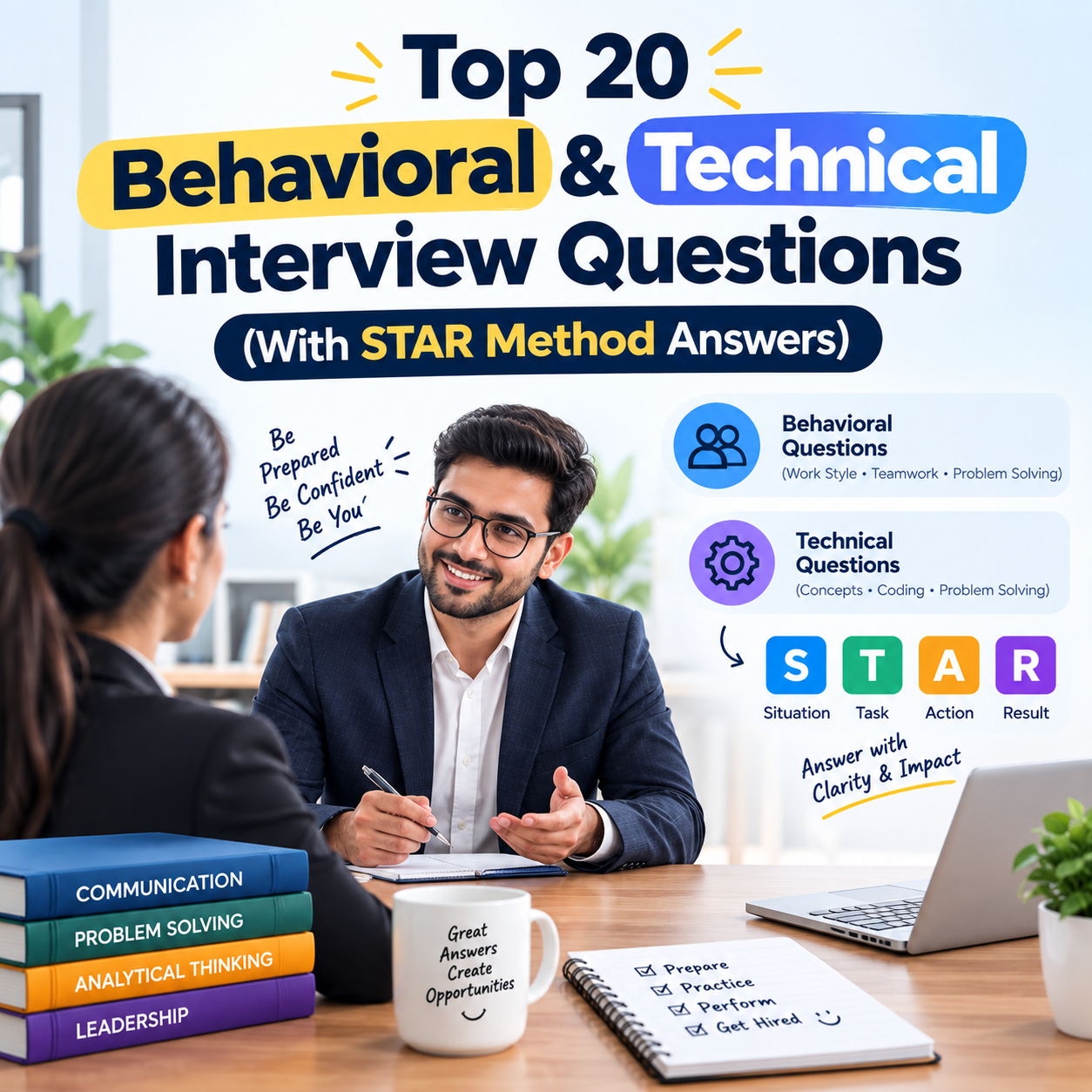
The single most reliable technique for answering situational prompts is the STAR methodology. Learning how to use the STAR method structure keeps your narrative clear and results-driven.
STAR Method Structural Breakdown:
• Situation (S): Set the context, project scope, and background (15% of your answer).
• Task (T): Define your specific responsibility and the core challenge (15% of your answer).
• Action (A): Detail the exact steps, tools, and decisions you executed (50% of your answer).
• Result (R): Share measurable business outcomes, metrics, and key learnings (20% of your answer).
Core Behavioral & Situational Questions
Understanding how to structure STAR method interview questions ensures you handle pressure-tested behavioral evaluations with complete confidence.
1. "Describe a situation where you had to manage a severe project delay."
Situation: During a quarterly platform migration, our third-party API integration team missed their deadline by three weeks.
Task: As lead technical coordinator, I had to prevent launch delays without compromising security testing.
Action: I restructured the remaining sprint into parallel tracks, implemented daily 15-minute unblocking standups, and personally re-architected the mock test environment so our frontend team could keep building without waiting for live endpoints.
Result: We launched the updated infrastructure with zero downtime, finishing only two days behind initial estimates and 15% under projected emergency engineering costs.
2. "Tell me about a time you had a fundamental disagreement with a stakeholder."
Situation: A product manager insisted on launching a resource-heavy analytics dashboard immediately, while engineering metrics showed it caused severe database latency.
Task: I needed to resolve the conflict without stalling the release cycle or alienating product leadership.
Action: Rather than arguing subjectively, I compiled a performance benchmark report showing the drop-off rate of slow pages. I then proposed a phased rollout: deploying an asynchronous cached summary immediately while scheduling background query optimizations for the next sprint.
Result: The stakeholder approved the compromise, user complaints dropped by 45%, and the feature achieved an 88% adoption rate.
Practicing structured STAR method interview questions builds composure, making complex situational interview questions easy to navigate under pressure.
Answering High-Stakes Standard & HR Questions
Standard introductory questions often set the tone for the entire interview. Preparing clear frameworks for HR round interview questions ensures you start on solid ground.
Introduction Blueprint:
Past Track Record (25%) ➔ Present Core Strengths (50%) ➔ Future Alignment with this Role (25%)
3. Strategic Framework for "Tell Me About Yourself"
When answering, "Tell me about yourself," avoid reciting your resume chronologically. Focus instead on a concise elevator pitch:
The Hook: Highlight your core expertise and years of domain experience.
Key Achievement: Mention one standout accomplishment backed by clear metrics.
The Pivot: Explain exactly why this specific role matches your career trajectory.
Executing this structure makes answering "Tell me about yourself"" impactful and engaging within two minutes.
4. "What is Your Greatest Professional Weakness?"
When evaluating how to answer weakness question prompts, never use transparent humblebrags like "I work too hard" or "I am a perfectionist."
Name a genuine, non-fatal operational weakness (e.g., "Early in my career, I struggled with over-delegating documentation during rapid deployments").
State the specific framework you implemented to correct it (e.g., "I now use automated sprint retrospectives and documentation checklists before closing tickets").
Show how your proactive fix improved your day-to-day workflow.
Knowing how to answer weakness question scenarios with honesty and self-awareness demonstrates maturity across all common job interview questions.
Technical Rounds, Freshers, and Salary Negotiations
Preparing for technical evaluations requires combining domain knowledge with clear communication.
1. Technical Preparation & Problem Solving
For software and data roles, cracking coding interview rounds requires talking through your logic out loud before typing syntax.
Structure your technical interview preparation by explaining time/space complexity trade-offs clearly to your interviewer.
2. Tailoring for Early-Career vs Experienced Profiles
Fresh graduates should focus on behavioral questions for freshers by highlighting academic capstone projects, hackathon initiatives, and open-source contributions.
Senior professionals facing interview questions for experienced professionals must emphasize leadership impact, architectural decisions, and cross-functional alignment.
3. Navigating Compensation Discussions
Handling salary negotiation questions requires grounding your expectations in market data rather than personal needs:
Avoid giving a rigid single number early in the process; provide a researched range based on industry benchmarks.
Highlight the total compensation package, including equity, performance incentives, and benefits.
Mastering these conversational milestones completes your behavioral interview guide, equipping you with proven top interview questions and answers for any hiring panel.
Pre-Interview Preparation Checklist
Structured 5 core career stories using the how to use STAR method framework.
Polished your introductory pitch for answering "Tell me about yourself.
Prepared honest, growth-oriented responses for how to answer weakness question prompts.
Reviewed fundamental data structures and system design for cracking coding interview stages.
Researched market compensation benchmarks to navigate salary negotiation questions.
Mastered this comprehensive behavioral interview guide covering both behavioral questions for freshers and interview questions for experienced professionals.
Frequently Asked Questions (FAQs)
1. Why are behavioral interview questions and answers weighted heavily by hiring managers?
Behavioral questions reveal how candidates handle real-world challenges, conflicts, and deadlines. Past behavior in professional settings is the most reliable predictor of future workplace performance and cultural fit.
2. How does the STAR method prevent rambling during high-pressure interviews?
The STAR method provides a clear narrative structure: Situation, Task, Action, and Result. This keeps candidates focused on actionable contributions and measurable results rather than getting bogged down in unnecessary background details.
3. What is the biggest mistake candidates make in technical interview preparation?
Focusing entirely on memorizing code syntax while ignoring communication. Top engineering teams look for problem-solving clarity, edge-case analysis, and the ability to explain technical trade-offs out loud.
4. How should fresh graduates approach behavioral questions without corporate experience?
Freshers can draw from university projects, internships, open-source work, and volunteer leadership. Focus on demonstrating problem-solving, personal accountability, and a willingness to learn.
5. When is the right time to address salary negotiation questions?
Ideally, discuss compensation after you have clearly established your value during the final rounds or once an offer is extended. If pressed early by recruiters, provide a researched salary range based on current industry standards.
6. What makes HR round interview questions different from hiring manager evaluations?
HR rounds primarily evaluate cultural alignment, communication skills, career trajectory, and salary expectations, whereas hiring manager rounds focus heavily on domain execution, technical skill, and day-to-day collaboration.