
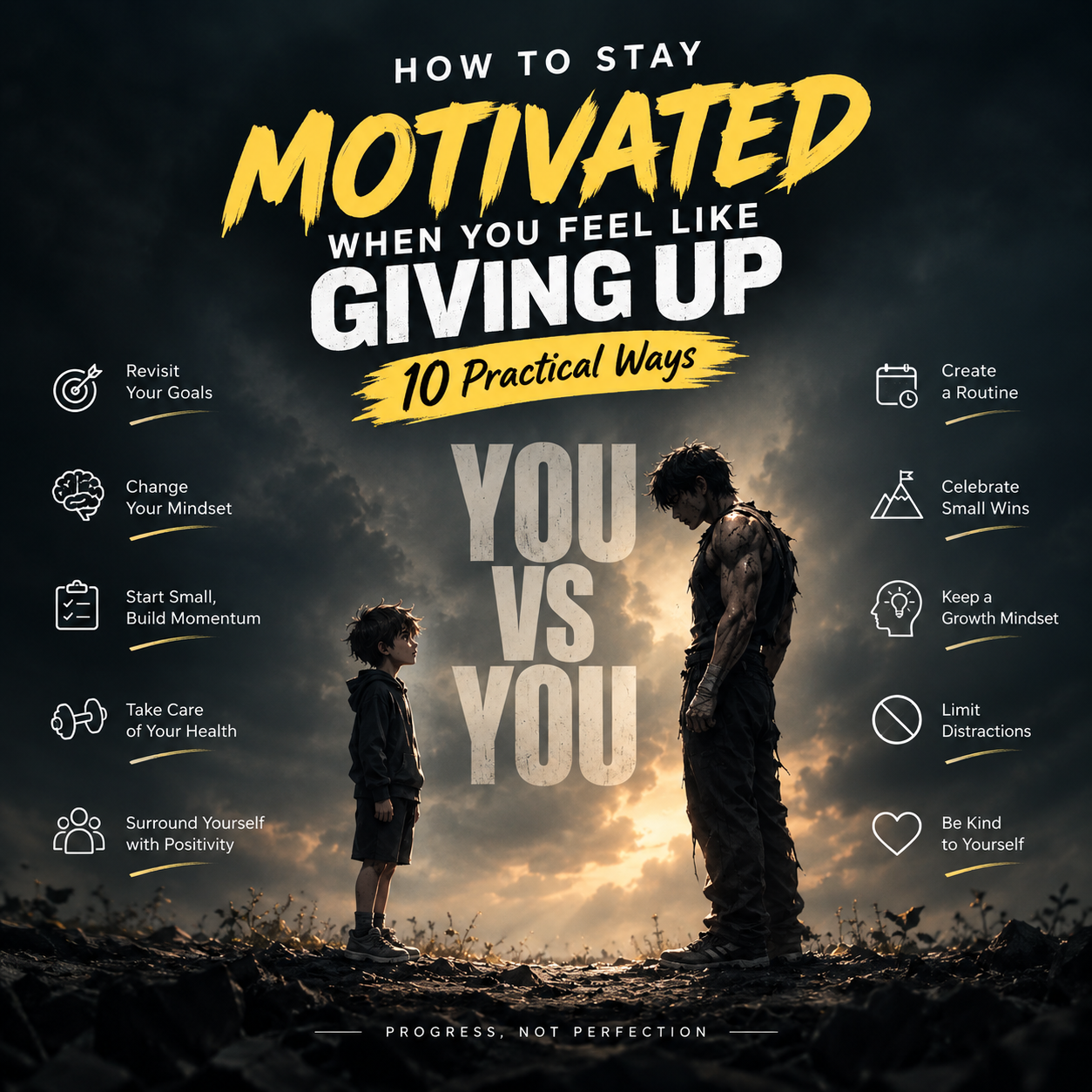
There are days when even simple things feel difficult. You may be tired of trying, disappointed by the results, or unsure whether your efforts are actually making a difference. When that happens, knowing how to stay motivated when you feel like giving up is less about finding a sudden burst of inspiration and more about learning how to take the next manageable step.
You do not have to feel confident, positive, or highly motivated before you move forward. Sometimes motivation returns after you take action, not before it.
This guide shares 10 practical ways to keep going when life feels difficult, including what to do after failure, how to regain your focus, and how to build habits that support you when motivation is low.
Why Do You Lose Motivation During Difficult Times?
Motivation naturally changes when life becomes stressful or uncertain.
A difficult situation can make the future feel unclear. Failure can make you question your abilities. Too many responsibilities can leave you mentally exhausted. Personal problems, work pressure, financial concerns, relationship difficulties, or repeated disappointment can also make it harder to concentrate on your goals.
Feeling discouraged during a difficult period does not automatically mean that you are lazy or incapable. People respond differently to challenging circumstances, and stress can affect how we think, feel and behave.
The goal, therefore, isn't to force yourself to feel positive every minute.
Instead, ask:
“What is one thing I can realistically do next?”
That question can be much more useful than asking yourself to solve your entire life at once.
How to Stay Motivated When You Feel Like Giving Up
1. Make the Next Step Smaller
When a goal feels overwhelming, your first response may be to avoid it completely.
Instead, shrink the task.
If you need to study, don't tell yourself, “I have to finish the entire chapter.”
Start with:
Open the book.
Read two pages.
Write down three important points.
Take a short break.
Continue if you feel able.
The same approach works at work, at home, and with personal goals.
Breaking difficult tasks into manageable pieces is also recommended as a practical way to deal with change and uncertainty.
Remember: progress does not have to look impressive to count.
2. Stop Waiting to Feel Motivated
One of the biggest misunderstandings about motivation is that you need to feel ready before you start.
Often, the opposite is more practical.
Take a small action first, then allow that action to create momentum.
For example:
Instead of:
“I'll exercise when I feel motivated.”
Try:
“I'll put on my shoes and walk for 10 minutes.”
Instead of:
“I'll work when I feel focused.”
Try:
“I'll work on this one task for 15 minutes.”
This approach is especially useful when you're learning how to overcome lack of motivation. You aren't trying to manufacture enthusiasm. You're reducing the effort required to begin.
3. Focus on What You Can Control
Difficult times often become more exhausting when you spend all your energy thinking about things you cannot change.
You cannot control every outcome, another person's reaction, the past, or every unexpected event.
You can often control:
What you do today
How you spend the next hour
Whether you ask for help
How you respond to a setback
Whether you take care of basic needs
What task you choose to tackle first
The American Psychological Association recommends focusing attention on what is within your control when uncertainty becomes stressful.
This shift can make motivation during difficult times feel less overwhelming.
4. Remember Why You Started
When progress is slow, the original reason behind your goal can become easy to forget.
Take five minutes and write down:
Why does this matter to me?
Your answer doesn't have to sound inspirational.
Maybe you want to:
Become financially independent
Improve your health
Support your family
Finish your education
Build a career
Become more confident
Create a better future
Prove something to yourself—not to other people
Your reason gives your effort context.
You may not be able to change the difficulty of the journey today, but remembering why you started can help you decide whether the journey is still worth continuing.
5. Stop Treating One Failure as the Final Result
Failure can make you think in extremes:
“I failed, so I'm not good enough.”
“This didn't work, so nothing will.”
“I made a mistake, so I should stop.”
But one unsuccessful attempt is information about one attempt. It does not automatically define your ability or your future.
If you're learning how to stay motivated after failure, try replacing:
“I failed.”
with:
“That approach didn't work. What can I learn from it?”
Then ask:
What went wrong?
What was outside my control?
What could I do differently?
What is one thing I can try next?
This doesn't mean pretending failure feels good. It means refusing to let one outcome make every future decision for you.
6. Build a “Minimum Day” Plan
Some days are simply harder than others.
Instead of expecting yourself to perform at 100% every day, create a minimum version of your routine.
For example:
On a normal day:
45-minute workout
2 hours of focused work
Cook a healthy meal
Read for 30 minutes
On a difficult day:
10-minute walk
One important work task
Eat something nourishing
Read one page
The minimum day is not an excuse to give up.
It's a way of maintaining continuity when your energy is low.
Over time, small actions can become easier to repeat, and resilience involves developing flexible ways of responding to difficult circumstances.
7. Talk to Someone Instead of Carrying Everything Alone
When you're struggling, isolation can make a difficult situation feel even heavier.
You don't necessarily need someone to solve your problem. Sometimes you simply need someone who will listen.
You could talk to:
A trusted friend
A family member
A mentor
A colleague
A counsellor or therapist
You can keep the conversation simple:
“I've been having a difficult time lately. I don't need you to fix it. I just need someone to talk to.”
Talking openly about mental health can make it easier to communicate what kind of support you actually need.
Asking for support is not a failure of independence. It can be part of learning how to keep going when life feels difficult.
8. Create a Small Daily Routine
When everything feels uncertain, a simple routine can give your day some structure.
You don't need a strict schedule.
Start with three anchors:
Morning: One thing you want to accomplish.
Afternoon: One important task you need to finish.
Evening: One activity that helps you slow down.
You might also include regular sleep, meals, movement, time outdoors, or contact with people you care about.
Looking after mental wellbeing regularly—not only when you're already struggling—can help you cope with future difficult periods.
These are some of the simplest ways to stay motivated every day because they reduce the number of decisions you have to make.
9. Be Careful About How You Talk to Yourself
When you're struggling, your internal dialogue can become much harsher than the way you would speak to someone you care about.
You might think:
“I'm useless.”
“I'll never succeed.”
“Everyone else is doing better.”
“I always mess things up.”
Pause and ask:
Would I say this to a friend who was going through the same thing?
If not, try a more balanced statement:
“I'm struggling right now, but I'm still trying.”
“This setback hurts, but it doesn't define everything.”
“I don't have to solve everything today.”
Self-compassion isn't the same as pretending everything is fine. Research has associated self-compassion with more action-oriented coping and less catastrophic thinking following stressful experiences.
Being kinder to yourself can make it easier to respond to a problem instead of spending all your energy criticizing yourself.
10. Keep a Record of Small Wins
When you're discouraged, your mind may focus heavily on what hasn't worked.
Create a simple “proof of progress” note on your phone.
Each evening, write down three things:
Something you completed
Something you handled well
Something you will try tomorrow
They can be very small.
For example:
Monday
Sent the difficult email.
Took a 15-minute walk.
Didn't give up on the project.
Tuesday
Finished one important task.
Called a friend.
Started again after making a mistake.
This exercise isn't about pretending small achievements are huge accomplishments. It's about noticing evidence that you are still taking action.
Reflecting on progress and recognizing achievements is also part of resilience-building guidance from the NHS.
What to Do When You Feel Like Giving Up
If you're having one of those days when everything feels too much, don't try to solve your entire future.
Try this five-step reset:
1. Pause
Step away from the problem for a few minutes if possible.
2. Name the problem
Write down exactly what is bothering you.
3. Separate facts from fears
Ask yourself:
What do I know for certain?
Then ask:
What am I assuming might happen?
4. Choose one controllable action
Pick something that can actually be done today.
5. Reassess tomorrow
You don't need to make every long-term decision while you're emotionally exhausted.
Sometimes how to find motivation again starts with giving yourself enough space to think clearly.
How to Stay Positive During Difficult Times Without Forcing Positivity
“Stay positive” can be frustrating advice when you're genuinely having a hard time.
You don't have to pretend that everything is okay.
A more realistic goal is balanced thinking.
Instead of:
“Everything is terrible and nothing will improve.”
Try:
“Things are difficult right now, but I don't know what will happen next.”
Instead of:
“I have completely failed.”
Try:
“This didn't go the way I wanted. I can decide what to do next.”
Positive thinking doesn't mean ignoring real problems. It means leaving room for possibilities while acknowledging what is actually happening.
How to Build Mental Resilience Over Time
Resilience isn't about becoming someone who never struggles.
The American Psychological Association describes resilience as adapting to difficult experiences through psychological, emotional and behavioural flexibility. It also notes that resilience-related skills and resources can be developed and practiced.
You can work on resilience by regularly practicing:
Problem-solving
Healthy routines
Supportive relationships
Self-compassion
Flexible thinking
Realistic goal-setting
Reflecting on past challenges
Think of resilience as a skill you strengthen through repeated practice—not a personality trait you either have or don't have.
When Motivation Problems May Need More Than Motivation Tips
Sometimes a lack of motivation is more than an ordinary rough patch.
If low mood persists, daily life becomes difficult to manage, or the things you're trying aren't helping, consider speaking with a qualified mental-health professional. Persistent low mood can have different causes and may require appropriate support or treatment.
And if “giving up” means that you are thinking about harming yourself or ending your life, don't rely on a motivation article to get through it. Reach out to a trusted person and seek immediate professional or emergency support.
In India, the Government of India's Tele-MANAS service provides mental-health support at 14416 or 1800-89-14416.
A Simple Daily Motivation Checklist
When you don't know what to do next, use this checklist:
Get out of bed and take care of the basics.
Drink some water and eat if you haven't.
Identify one important task.
Break that task into the smallest possible step.
Spend a few minutes moving or getting outside.
Talk to someone you trust if you're struggling.
Write down one thing you accomplished.
Decide what tomorrow's first small step will be.
You don't have to complete everything.
The goal is to keep a connection with forward movement.
Final Thoughts
Learning how to stay motivated when you feel like giving up isn't about becoming positive all the time or forcing yourself to keep pushing when you desperately need rest.
Sometimes staying motivated means doing less—but doing something.
Take the next small step. Ask for help when you need it. Learn from setbacks without turning them into a judgment about your entire future. Give yourself the same patience you would offer someone you care about.
You don't need to know exactly how everything will work out.
For today, you only need to decide what your next step can be.
Frequently Asked Questions
1. How do I stay motivated during hard times?
Start by reducing your focus from the entire problem to the next manageable action. Build a simple routine, focus on what you can control, talk to supportive people, and recognize small progress rather than expecting constant motivation.
2. What should I do when I feel like giving up?
Pause and identify what is making the situation feel overwhelming. Separate what you can control from what you cannot, choose one small action, and consider talking to someone you trust. If you're experiencing persistent low mood or thoughts of self-harm, seek professional support rather than trying to handle it alone.
3. How can I regain motivation in life after failure?
Give yourself time to process the setback, then examine what you can learn from it. Separate the result from your identity, adjust your approach and choose one small next step. Motivation often becomes easier to rebuild when a large goal is turned into manageable actions.
4. How can I stay focused when life is hard?
Reduce distractions, choose one priority and work on it for a short, defined period. Breaking responsibilities into smaller tasks can make difficult situations feel more manageable.
5. How can I keep moving forward in life when I don't feel motivated?
Don't make motivation the requirement for action. Choose a small task you can complete today, maintain basic routines, stay connected with supportive people and give yourself permission to progress slowly. Moving forward can sometimes mean taking one small step rather than making a dramatic change.